
Introduction
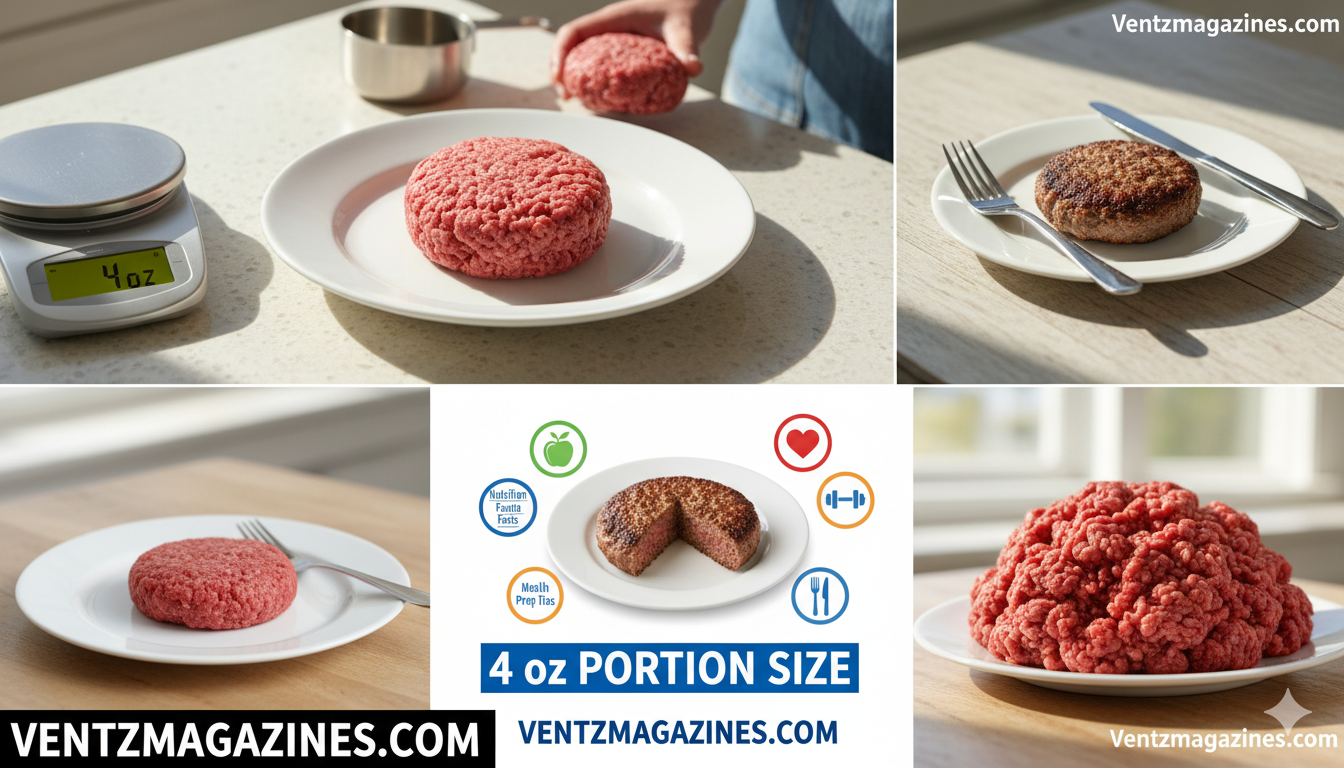
What does 4 oz of ground beef look like is a common question for anyone tracking portions, counting calories, or following a meal plan.
Four ounces of ground beef equals roughly the size of a deck of cards, fits in the palm of your hand, or measures about half a cup when packed.
This standard serving size contains approximately 20-30 grams of protein depending on the fat percentage, making it perfect for burgers, tacos, meal prep, and healthy eating goals.
Understanding what this portion looks like helps with weight management, calorie control, and ensuring you’re getting adequate protein without overeating.
In this comprehensive guide, you’ll discover visual comparisons, measurement techniques without a scale, nutritional information, cooking tips, and everything you need to confidently portion 4 oz of ground beef every single time.
Table of Contents
Quick Facts About 4 Oz of Ground Beef
| Category | Details |
|---|---|
| Weight | 4 ounces (113 grams) |
| Visual Size | Deck of cards, palm of hand |
| Volume Packed | Approximately 1/2 cup |
| Burger Patty Size | 2.5 inches diameter, 1 inch thick |
| Equivalent | 1/4 pound of beef |
| Cooked Weight | Approximately 3 ounces |
| Calories (80/20) | 284 calories |
| Calories (93/7) | 170-180 calories |
| Protein (80/20) | 19-21 grams |
| Protein (93/7) | 23-24 grams |
| Fat (80/20) | 23 grams |
| Fat (93/7) | 7-9 grams |
| Serving Type | Standard single serving |
Visual Comparisons: What 4 Oz Looks Like
Deck of Cards Comparison
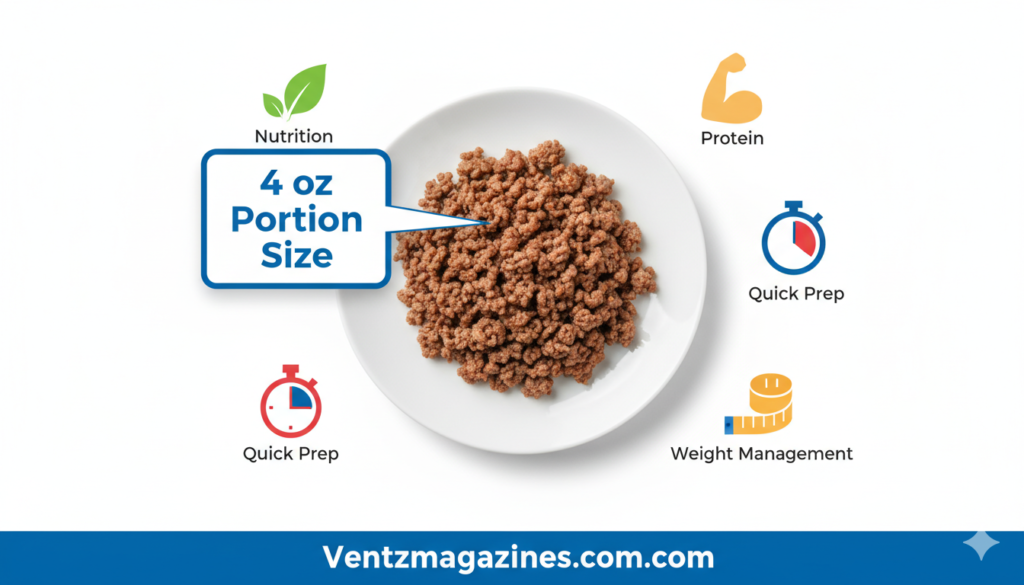
The most popular visual comparison is a standard deck of playing cards. Four ounces of ground beef matches the deck’s size in length, width, and thickness.
When shaped into a patty, 4 oz of raw ground beef creates a round disk. It measures about 2.5 inches in diameter and roughly 1 inch thick.
This is the same size as a typical fast-food hamburger patty. Quarter pounders at restaurants start with 4 oz of raw beef before cooking.
The deck of cards method works for all types of meat. It’s a universally recognized portion size reference that’s easy to remember.
Palm of Your Hand
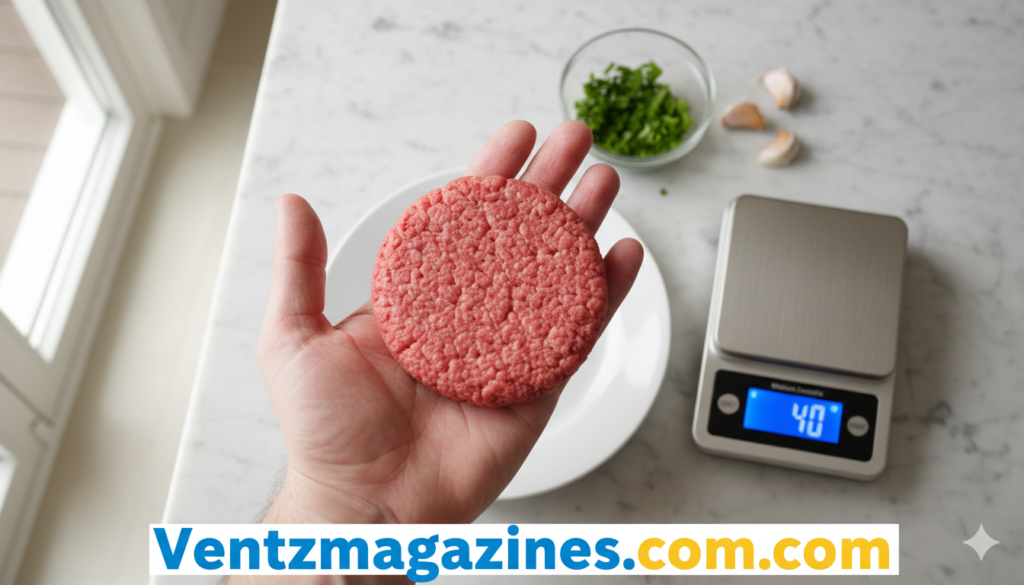
Another reliable visual guide is your palm size. An adult palm can hold approximately 3-4 ounces of ground beef comfortably.
Place the ground beef in your palm excluding fingers and thumb. The meat should cover your palm without spilling over the edges.
This method accounts for individual differences in hand size. Women’s hands typically hold 3 oz, while men’s hands hold 4 oz.
Remember that palm measurements work best for shaped patties or meatballs. Crumbled ground beef is harder to measure accurately using hands.
Half Cup Measurement
When packed firmly, 4 oz of raw ground beef equals roughly half a cup. This volume measurement provides another estimation method without a scale.
Use a standard 1/2 cup measuring cup and pack the beef tightly. Press down firmly to remove air pockets for accurate measurement.
This method works better for uncooked ground beef than cooked. Cooked ground beef crumbles differently and may not pack the same way.
Keep in mind that volume measurements are less accurate than weight. Fat content and beef texture affect how tightly it packs.
Meatball Size Reference
One ounce of ground beef makes a 1-inch diameter meatball. Therefore, 4 ounces would create a 4-inch meatball when shaped.
More practically, 4 oz makes four 1-inch meatballs. Or you could make two 2-inch meatballs for a hearty serving.
This visualization works great for meal prep and portion control. Pre-forming meatballs ensures consistent serving sizes throughout the week.
Restaurant meatballs typically range from 1.5 to 2 inches. This means a single large restaurant meatball contains 2-3 ounces of meat.
Tennis Ball Comparison
A tennis ball provides another household comparison for 4 oz portions. Four ounces of shaped ground beef is slightly smaller than a tennis ball.
The tennis ball comparison works for loosely packed or shaped beef. It’s less accurate than the deck of cards but useful for quick estimates.
If you’re forming burger patties, flatten your tennis ball-sized portion. This creates the perfect thickness and diameter for standard burgers.
Understanding Raw vs Cooked Weight
Weight Loss During Cooking
Ground beef shrinks significantly when cooked due to moisture and fat loss. Raw beef loses approximately 25% of its weight during cooking.
Four ounces of raw ground beef becomes roughly 3 ounces when fully cooked. This shrinkage depends on cooking method and fat content.
Higher fat content means more shrinkage during cooking. 80/20 ground beef loses more weight than 93/7 lean beef.
The cooking method also impacts final weight. Grilling and pan-frying cause more shrinkage than baking or steaming.
Why This Matters for Calorie Counting
Nutritional information on packages refers to raw meat weight. This creates confusion when tracking calories after cooking.
If you weigh meat after cooking, you’re underestimating your portion size. Three ounces cooked originally weighed 4 ounces raw.
For accurate calorie tracking, always weigh meat before cooking. Adjust by adding 1 ounce to your target cooked weight.
Alternatively, use cooked meat nutritional databases specifically. These show accurate values for cooked weights to prevent errors.
Best Practices for Weighing
Weigh ground beef in its raw state before forming or cooking. This provides the most accurate nutritional tracking possible.
If you must weigh after cooking, divide total cooked weight by 0.75. This reverse calculation estimates the original raw weight.
For meal prep, weigh and portion raw beef immediately. Freeze individual 4 oz portions for grab-and-go convenience.
Cooking Method Impact
Grilling causes the most moisture and fat loss (25-30% shrinkage). The high heat drains fat and evaporates moisture rapidly.
Pan-frying on medium heat loses about 20-25% of weight. Some fat renders into the pan while moisture evaporates.
Baking in the oven at 350°F retains more moisture (15-20% loss). The gentler cooking method prevents excessive shrinkage.
Slow cooking or braising maintains weight better (10-15% loss). The moist environment prevents excessive moisture evaporation.
Measuring Without a Scale
Using Measuring Cups
Measuring cups offer an alternative to food scales. One pound of cooked ground beef equals approximately 2 cups.
Since 4 oz is 1/4 pound, it equals roughly 1/2 cup cooked beef. This gives you a quick estimation without weighing.
Pack the ground beef firmly into the measuring cup. Compress it to remove air pockets for better accuracy.
This method works for both raw and cooked ground beef. Just remember raw beef packs tighter than cooked crumbles.
The Water Displacement Method
Fill a container with exactly 1 quart (32 oz) of water. One quart of water weighs 2 pounds (32 oz by weight).
Place ground beef in a sealed plastic bag. Submerge it in water and note the water level rise.
Each 4 oz of beef displaces roughly 1/2 cup of water. This physics-based method provides surprising accuracy.
This technique works best with raw beef in sealed packaging. Cooked beef crumbles make water displacement impractical.
Using Tablespoons
One serving of ground beef equals approximately 18 tablespoons. This converts to 1.125 cups per 4 oz serving.
While technically accurate, tablespoon measurement is tedious and impractical. It’s better for small amounts or recipe adjustments.
If using this method, pack each tablespoon firmly. Count carefully and consider this a rough estimate only.
Comparison Objects Around Your Kitchen
A standard smartphone is similar in size to 4 oz patty. Place shaped beef next to your phone for quick comparison.
A computer mouse is roughly 3-4 ounces when shaped similarly. This office supply provides another convenient reference point.
A baseball is slightly larger than 4 oz of shaped beef. Use it as an upper limit for portion size estimation.
The bottom of a standard coffee mug holds about 4 oz. Pack beef into the mug base for circular portion forming.
Nutrition Information by Fat Percentage
80/20 Ground Beef (Regular)
This is the most common ground beef with 20% fat content. Four ounces raw contains approximately 284 calories.
Protein content is 19-21 grams per 4 oz serving. Fat content is approximately 23 grams per serving.
Saturated fat totals about 9 grams in 4 oz. This represents 45% of daily recommended saturated fat intake.
Cholesterol content is around 80mg per serving. This equals about 27% of the daily recommended limit.
85/15 Ground Beef (Lean)
This moderately lean beef contains 15% fat content. Four ounces raw provides approximately 243 calories.
Protein increases to 22-24 grams per serving. Fat decreases to approximately 17 grams per 4 oz.
Saturated fat drops to about 7 grams per serving. This makes it a healthier choice for regular consumption.
The flavor remains rich while reducing overall fat intake. This balance makes 85/15 popular for everyday cooking.
90/10 Ground Beef (Extra Lean)
This lean option contains only 10% fat content. Four ounces raw equals approximately 200 calories.
Protein content rises to 24-25 grams per serving. Fat content drops to just 11 grams per portion.
Saturated fat is only 4.5 grams per 4 oz serving. This significantly reduces cardiovascular health concerns.
The meat tends to dry out more easily when cooking. Add moisture through sauce or don’t overcook for best results.
93/7 and 96/4 Ground Beef (Leanest)
These ultra-lean options contain 7% or 4% fat respectively. Calories range from 150-180 per 4 oz serving.
Protein content maxes out at 25-26 grams per serving. Fat content drops to just 7-9 grams total.
Saturated fat is minimal at 2-4 grams per serving. These options suit strict low-fat or bodybuilding diets.
The meat can become very dry during cooking. Cook with added oil or moisture to maintain palatability.
Grass-Fed vs Grain-Fed Differences
Grass-fed ground beef typically runs leaner than grain-fed. The fat percentage may be lower for the same labeled ratio.
Grass-fed beef contains more omega-3 fatty acids. It also provides higher levels of conjugated linoleic acid (CLA).
The flavor profile differs with a grassier, earthier taste. Some prefer it while others find it too strong.
Nutritionally, grass-fed offers slightly better fat quality. However, protein content remains similar to grain-fed beef.
Perfect Portion Sizes for Different Meals
Hamburgers and Sliders
A standard hamburger uses 4 oz of raw ground beef. This creates a satisfying single-patty burger after cooking.
The cooked patty weighs approximately 3 oz, perfect for a bun. It provides adequate protein without being overwhelming.
For sliders, use 2 oz portions instead of 4. This creates mini burgers perfect for parties and appetizers.
Double burgers use 8 oz total (two 4 oz patties). This creates a substantial meal with 40-50g protein.
Tacos and Burritos
Each taco should contain 2-3 oz of cooked ground beef. This means 4 oz raw makes filling for 1.5-2 tacos.
Plan for 2-3 tacos per person as a meal. Use 6-8 oz raw beef per person for proper portions.
Burritos require more filling, using 3-4 oz cooked beef. Start with 4-5 oz raw beef per large burrito.
For taco salads, use a full 4 oz cooked beef. This provides adequate protein for the lighter vegetable base.
Spaghetti and Meat Sauce
A family-style meat sauce uses 1-2 oz beef per serving. Four ounces raw serves 2-3 people in pasta dishes.
The beef should complement, not overwhelm, the pasta. Too much meat makes sauce too heavy and expensive.
For individual meal prep, use full 4 oz per container. This creates a protein-rich single-serving meal.
Meatballs and Meatloaf
Standard meatballs use 1-1.5 oz each of ground beef. Four ounces makes 2-3 large or 4 small meatballs.
Italian wedding soup meatballs are typically 1/2 oz each. Four ounces makes about 8 tiny soup meatballs.
Meatloaf portions should be 4-6 oz cooked per person. Factor in eggs, breadcrumbs, and other binders when measuring.
Swedish meatballs traditionally use 1.5 oz portions. Four ounces of beef makes 2-3 Swedish meatballs.
Stuffed Peppers and Casseroles
One stuffed pepper typically needs 3-4 oz cooked beef filling. Use 4-5 oz raw beef per large bell pepper.
Casseroles distribute meat throughout the dish. Calculate 3-4 oz cooked beef per serving then multiply.
For a 9×13 casserole serving 8 people, use 2 lbs raw beef. This provides approximately 4 oz raw per person.
Meal Prep Bowls
Standard meal prep uses 4 oz raw beef per container. This provides 20-25g protein per single-serve meal.
Pair beef with 1 cup cooked rice and vegetables. This creates a balanced, portioned meal for the week.
For weight loss, reduce to 3 oz raw beef per bowl. Add extra vegetables to maintain volume and satisfaction.
Bodybuilders might use 6-8 oz raw beef per meal. This significantly increases protein for muscle building goals.
Cooking Tips for Perfect 4 Oz Portions
Pre-Portioning Raw Meat
Buy ground beef in bulk and portion immediately at home. Divide into 4 oz servings before freezing for convenience.
Use a kitchen scale for accurate initial measurements. After a few times, you’ll estimate 4 oz by sight.
Flatten portions into patties before freezing. This allows faster defrosting and easier burger preparation later.
Separate portions with parchment or wax paper. This prevents frozen patties from sticking together in storage.
Forming Perfect Patties
Make a small dimple in the center of each patty. This prevents bulging during cooking and ensures even thickness.
Don’t overwork the meat when forming patties. Excessive handling makes burgers dense and tough instead of juicy.
Create patties slightly larger than your bun. Meat shrinks during cooking, and oversized patties fit buns perfectly.
Season patties just before cooking, not during forming. Salt draws out moisture if applied too early.
Preventing Overcooking
Use a meat thermometer for accuracy every time. Ground beef reaches safe temperature at 160°F (71°C).
Don’t press patties with a spatula while cooking. This squeezes out flavorful juices and dries the meat.
Flip burgers only once during cooking. Multiple flips dry out meat and prevent proper browning.
Let cooked beef rest 2-3 minutes before serving. This allows juices to redistribute throughout the meat.
Retaining Moisture in Lean Beef
Add a small amount of fat when cooking 93/7 beef. One teaspoon of olive oil prevents excessive drying.
Mix in breadcrumbs or oats to retain moisture. These absorbers hold onto juices during the cooking process.
Don’t overcook lean beef past 160°F internal temperature. Extra cooking makes lean beef unpalatably dry.
Consider adding diced onions or mushrooms to the mix. These vegetables release moisture during cooking.
Best Cooking Methods
Pan-frying in a cast iron skillet creates excellent crust. Preheat pan to medium-high heat for best results.
Grilling imparts smoky flavor but causes most shrinkage. Oil the grill grates to prevent sticking.
Baking on a sheet pan at 375°F works for meal prep. This method cooks multiple portions evenly simultaneously.
Air frying at 370°F for 10 minutes creates crispy exteriors. Flip halfway through for even cooking.
Meal Prep and Storage Tips
Freezing Individual Portions
Freeze raw 4 oz portions individually wrapped in plastic wrap. Add a layer of foil for extra freezer burn protection.
Label each portion with date and weight clearly. This tracking prevents mystery meat situations months later.
Stack flat portions in freezer bags for space efficiency. Frozen patties take up less room than bulky packages.
Properly frozen ground beef lasts 3-4 months safely. Beyond this, quality degrades though it remains safe to eat.
Defrosting Safely
Defrost overnight in the refrigerator for food safety. This slow method prevents bacterial growth during thawing.
For quick defrosting, use cold water bath method. Submerge sealed beef in cold water, changing water every 30 minutes.
Microwave defrosting works in a pinch but cooks edges. Use immediately after microwave defrosting for safety.
Never defrost ground beef on the counter at room temperature. This creates dangerous bacterial growth conditions.
Cooked Beef Storage
Store cooked ground beef in airtight containers in refrigerator. Use within 3-4 days for optimal safety and quality.
Freeze cooked beef in portion-sized containers for longer storage. Cooked beef freezes well for 2-3 months.
Cool cooked beef quickly before refrigerating or freezing. Spread in a shallow pan for rapid cooling.
Reheat cooked beef to 165°F internal temperature. This kills any bacteria that grew during storage.
Meal Prep Container Ideas
Glass meal prep containers preserve quality better than plastic. They’re microwave-safe and don’t absorb odors or stains.
Divide 4 oz beef, starch, and vegetables into compartments. This creates balanced, grab-and-go meals all week.
Mason jars work great for taco salads with beef. Layer ingredients with beef on top for easy assembly.
Silicone muffin cups create perfect mini meatloaf portions. Each cup holds approximately 3-4 oz of meat mixture.
Shopping and Selecting Ground Beef
Reading Package Labels
Ground beef labels show the lean-to-fat ratio clearly. 80/20 means 80% lean meat, 20% fat by weight.
Check the total weight on the package. Calculate how many 4 oz portions you’ll get from each package.
Look at the sell-by or use-by date carefully. Buy the freshest package available for maximum shelf life.
Compare price per pound rather than total price. Leaner beef costs more but provides better value nutritionally.
Bulk Buying Strategy
Family packs offer significant savings per pound. Buy in bulk and portion immediately at home.
Warehouse stores sell ground beef in 5-10 lb packages. Split large packages into 4 oz portions for freezing.
Watch for manager’s specials on meat near sell-by dates. These are safe to buy and freeze immediately.
Ground beef frequently goes on sale around holidays. Stock up during sales and freeze for later use.
Organic vs Conventional
Organic ground beef comes from cattle without hormones or antibiotics. It costs 30-50% more than conventional beef.
Nutritionally, organic and conventional beef are very similar. The main differences are farming practices, not nutrients.
Grass-fed options are often organic but not always. Read labels carefully to understand what you’re buying.
Choose organic if you prioritize animal welfare and environmental concerns. Otherwise, conventional beef provides similar nutrition.
Freshness Indicators
Fresh ground beef appears bright red in the center. Some brown or gray on the surface is normal from oxygen exposure.
The meat should smell fresh, not sour or ammonia-like. Any off smell indicates spoilage regardless of date.
Packages should be cold to the touch in the store. Check that refrigeration units maintain proper temperature.
Avoid packages with excessive liquid pooling at bottom. This suggests the meat is older or improperly stored.
Using 4 Oz Portions for Weight Management
Calorie Control Benefits
Pre-portioned 4 oz servings prevent accidental overeating. You consume exactly the calories you planned for.
Consistent portions make calorie tracking effortless and accurate. No guessing or estimating required during meal time.
Four ounces provides adequate protein while controlling fat intake. This supports weight loss without feeling deprived.
Smaller controlled portions leave room for vegetables and sides. You create balanced meals within calorie budgets.
Protein Goals for Different Diets
Weight loss diets need 0.8-1g protein per pound bodyweight. A 150-lb person needs 120-150g protein daily.
Four ounces of 93/7 beef provides 24g protein. This represents 16-20% of daily protein goals.
Bodybuilding requires 1-1.5g protein per pound of bodyweight. A 180-lb bodybuilder needs 180-270g protein daily.
Athletes training intensely need similar high protein amounts. Multiple 4 oz portions throughout the day help meet goals.
Portion Control Psychology
Smaller portions on smaller plates look more satisfying. Use 8-9 inch plates rather than 11-12 inch plates.
Pre-plated portions prevent unconscious seconds and thirds. You decide portions beforehand, not while eating.
Eating slowly allows satiety signals to reach the brain. A 4 oz portion feels more satisfying when eaten mindfully.
Pairing beef with high-volume vegetables extends the meal. Bulk from vegetables creates fullness without extra calories.
Tracking Methods
Use a food journal or app to log portions. Many apps have barcode scanners for packaged ground beef.
Take photos of portioned meals for visual accountability. Pictures help you stay consistent with serving sizes.
Weigh portions weekly even after learning to estimate. Periodic verification prevents portion creep over time.
Track not just portion size but cooking method too. Pan-frying in butter adds more calories than grilling.
Restaurant and Fast Food Comparisons
Fast Food Burger Sizes
McDonald’s Quarter Pounder starts with 4 oz raw beef. After cooking, it’s approximately 3 oz of actual meat.
Burger King’s Whopper uses a 4 oz patty also. Most standard fast-food burgers use this portion size.
Five Guys regular burger uses two 3.3 oz patties. Their “little” burger uses one patty similar to 4 oz.
In-N-Out standard burger uses a 2 oz patty. Their double-double uses two 2 oz patties totaling 4 oz.
Casual Dining Portions
Chain restaurants often serve 6-8 oz cooked burgers. This equals 8-10 oz of raw beef before cooking.
Steakhouse burgers can reach 10-12 oz cooked weight. These massive portions contain 500-600 calories from meat alone.
“Pub” style burgers typically use 6 oz patties minimum. Half-pound burgers start with 8 oz raw beef.
Slider portions in restaurants use 2-3 oz cooked beef. This equals approximately 3-4 oz raw per slider.
Comparing Value and Nutrition
Fast food 4 oz burgers cost $4-7 including bun and toppings. Home preparation costs $1.50-3 per 4 oz serving.
Restaurant burgers often use fattier 80/20 beef. Home cooking allows you to choose leaner options.
Hidden calories come from butter on buns and cooking fat. Restaurants use more fat for flavor and texture.
Sodium content is much higher in restaurant burgers. Home cooking allows you to control salt levels.
Common Mistakes to Avoid
Weighing After Cooking
The most common mistake is weighing cooked instead of raw meat. This underestimates your actual portion by 25%.
Nutrition labels always reflect raw weight unless specified. Weighing cooked meat makes calorie tracking inaccurate.
If you must weigh cooked meat, use cooked meat databases. These show correct values for cooked weights.
Or divide cooked weight by 0.75 to estimate raw weight. This reverse calculation corrects for moisture loss.
Packing Too Loosely
When using measuring cups, loose packing gives inaccurate measurements. Ground beef with air pockets seems like more.
Press beef firmly into measuring cups. Compact it to remove air spaces for better accuracy.
Loosely crumbled cooked beef is especially problematic. It can be off by 50% or more.
For cooked beef measurements, press very firmly. Or better yet, weigh it instead of using cups.
Not Accounting for Added Ingredients
Meatballs and meatloaf include eggs, breadcrumbs, and seasonings. These additions increase total weight beyond just meat.
If tracking meat protein specifically, calculate the percentage. A meatloaf that’s 80% beef needs adjusted portions.
For recipes with lots of fillers, weigh just the meat. Then calculate your true meat portion afterward.
Taco seasoning adds sodium but minimal weight. However, moisture from cooking can affect final measurements.
Eyeballing Without Verification
After learning portion sizes, many people stop verifying. Portion creep slowly increases serving sizes over weeks.
Weigh portions once weekly even when experienced. This prevents gradual portion size inflation.
Our hands and eyes are not as accurate as we think. Studies show most people underestimate portions by 30-50%.
Use measuring tools at least occasionally for accuracy. Think of it as calibrating your eyeballs regularly.
Frequently Asked Questions
How much does 4 oz of ground beef look like?
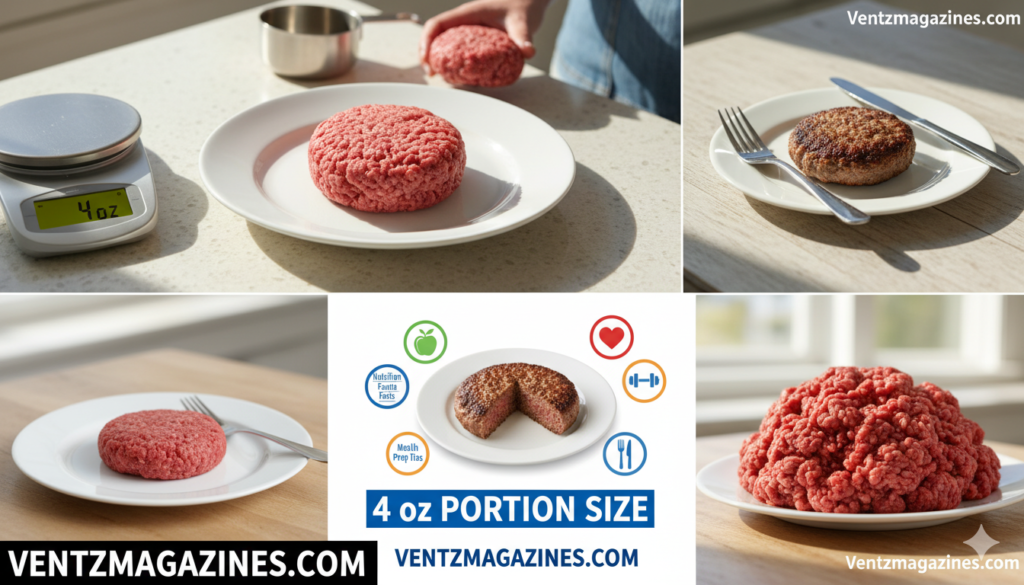
Four ounces of ground beef looks like a deck of playing cards in size, fits in the palm of your hand, or equals about half a cup when packed firmly. When shaped into a burger patty, it’s approximately 2.5 inches in diameter and 1 inch thick before cooking.
How many calories are in 4 oz of ground beef?
The calories in 4 oz of ground beef range from 150-284 calories depending on fat content. Regular 80/20 beef contains 284 calories, 85/15 lean beef has 243 calories, and 93/7 extra lean beef provides only 170-180 calories per 4 oz serving.
How much protein is in 4 oz of ground beef?
Four ounces of ground beef contains 19-26 grams of protein depending on the lean percentage. Regular 80/20 beef provides 19-21g protein, 85/15 lean offers 22-24g protein, and 93/7 extra lean delivers 24-26g protein per serving.
Can I measure 4 oz without a scale?
Yes, you can measure 4 oz of ground beef using your palm (covers adult palm), a deck of cards (same size), or 1/2 cup measuring cup (packed firmly). These visual methods provide reasonably accurate estimates when a scale isn’t available.
Does 4 oz of beef shrink when cooked?
Yes, 4 oz of raw ground beef shrinks to approximately 3 oz when cooked due to moisture and fat loss. The meat loses about 25% of its weight during cooking, with higher-fat beef shrinking more than lean beef.
How many burgers does 1 lb of ground beef make?
One pound (16 oz) of ground beef makes four 4-ounce burger patties, which is the standard single-patty burger size. These are quarter-pound burgers similar to what fast-food restaurants serve before cooking.
Should I weigh ground beef raw or cooked?
Always weigh ground beef raw before cooking for accurate calorie tracking. Nutritional information on packages refers to raw weight, and cooking causes 25% weight loss that varies by cooking method and fat content.
What’s the best ground beef for weight loss?
The best ground beef for weight loss is 93/7 or 96/4 extra lean, containing only 150-180 calories per 4 oz serving with maximum protein (24-26g). Leaner beef provides more protein with less fat and fewer total calories.
How long does 4 oz of ground beef last in the fridge?
Raw ground beef lasts 1-2 days in the refrigerator when properly stored. Cooked ground beef lasts 3-4 days refrigerated in an airtight container. Always freeze ground beef if you won’t use it within these timeframes.
How many 4 oz portions are in a pound of ground beef?
One pound of ground beef contains exactly four 4-ounce portions since 16 ounces equals 1 pound. This makes it easy to divide store packages into standard single-serving portions for meal prep or individual meals.
Conclusion
What does 4 oz of ground beef look like becomes crystal clear once you use visual references like a deck of cards, the palm of your hand, or a half cup measurement.
This standard portion size provides the perfect balance of protein, calories, and satisfaction for most meal plans whether you’re managing weight, building muscle, or simply cooking healthy meals.
Understanding both the visual appearance and nutritional content empowers you to make informed decisions about your protein intake without obsessively weighing every meal.
Four ounces of ground beef delivers 19-26 grams of protein depending on fat percentage, making it an efficient and affordable protein source that fits almost any dietary goal.